NICCOLÒ MACHIAVELLI
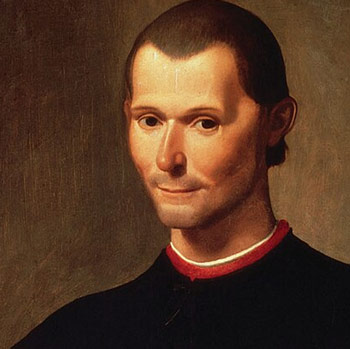
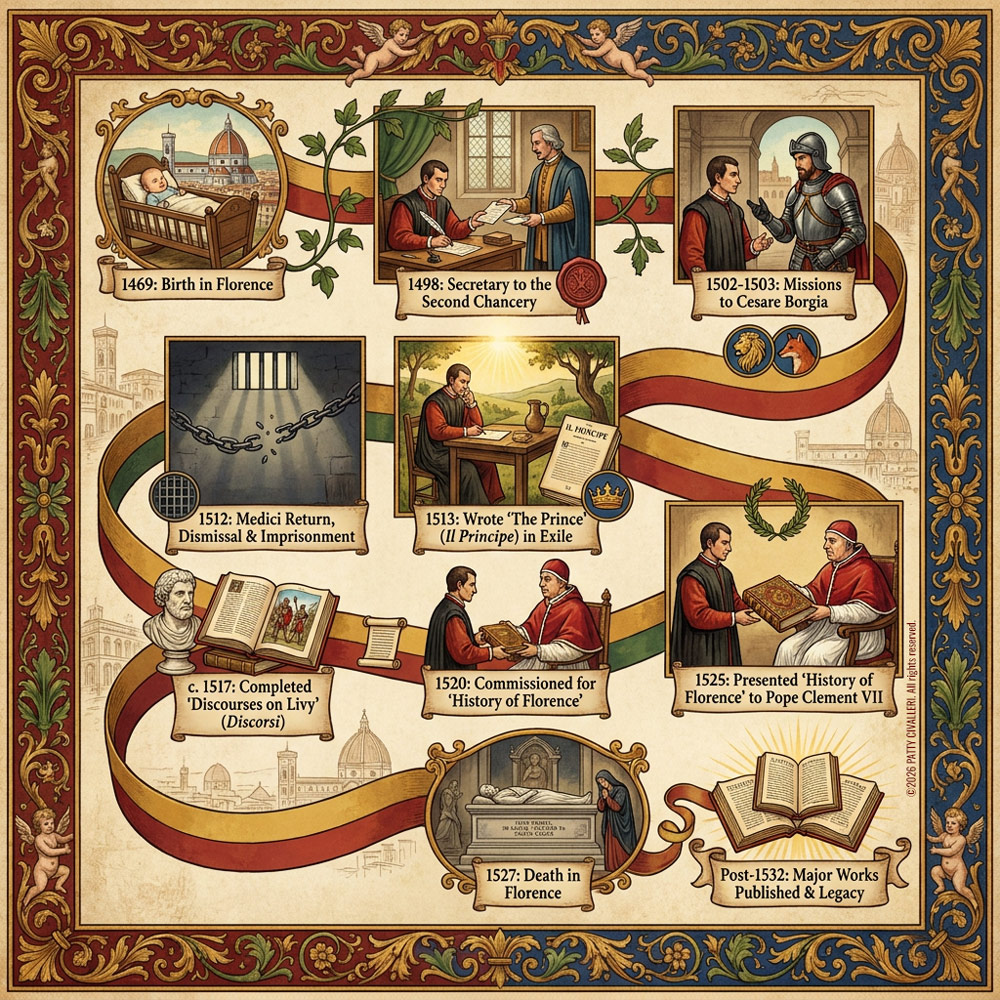
Niccolò di Bernardo dei Machiavelli was born in Florence in 1469, the same year that Lorenzo de’ Medici came into power. Interestingly enough, his pro-Republic political views were diametrically opposed to the Medici way of doing ‘business’.
As a child in a family of means, he was schooled in grammar and Latin. Few folks at that time possessed the ability to read and write, but because the printing press was well underway to producing a hailstorm of materials, the demand for ‘readers’ was far greater than the supply.
The death of Lorenzo de’ Medici in 1492 fed the fire of political upheaval for the next few decades to come. This was the perfect time for a quiet guy like Machiavelli, who opposed the Medici ‘regime’ to come into the spotlight.
After Savonarola was executed in 1498 (p<?>), Machiavelli was appointed to the position of the keeper of the Official Florentine Government Documents for the renewed Republic. In addition he was appointed to the “Dieci di Libertà e Pace” (Ten of Liberty & Peace), the Ministers of War and the Interior. But seeing the brutal practices of the recent Pope Alexander VI (Rodrigo Borgia) and his son Cesare, who commonly used the Church as the excuse to bring most of central Italy under their power, Machiavelli made several ultimately unsuccessful trips to Rome to meet with the new Pope Julius II to use his diplomatic skills to find areas of commonality.
Julius II, used his relationship with the Pope to convince him to utilize the Spanish Army to subdue the Florence Republic and to place the Medici family back in power.
Machiavelli, believed that the best armies are those that are populated with local men who possess a vested love for their home land - rather than the unstable loyalties of a hired militia. He gathered people from in and around Florence to ward off the onslaught of the Pope. Whether they were armed with pitchforks, shovels or guns, they awaited the Pope’s army. But very quickly, his citizen’s army was wiped out in a bloodbath that resulted in the Medici retaking Florence, the renewed downfall of the Republic, and the arresting of Machiavelli by the new Medici enforcers.
While in prison under the charges of conspiracy against the Medici, Machiavelli endured harsh torture suffering two dislocated shoulders, all the while maintaining his innocence. After three weeks, he was released and exiled from his hometown of Florence. It was during this exile that he penned his famous book The Prince. Today, Machiavelli’s book is still read globally to teach the ‘Machiavellian’ perspectives and their impact in political, social, and economic environments.
Exerpt from Florence Travel book FLORENCE GEMS & GIANTS by Patty Civalleri.
1-Minute Machivelli