
How was the Pantheon’s dome built without supports?
Roman builders used an immense unreinforced concrete shell that becomes thinner and lighter toward the oculus, carried by the rotunda’s massive walls.
Fact-Check & Sources
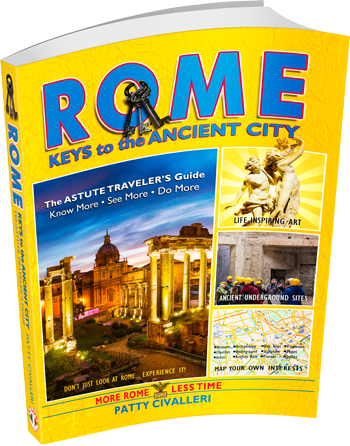
Sources: ROME: Keys to the Ancient City, printed pages 186–187 (PDF pages 184–185). Cross-checked 21/09/2026 against the Pantheon Basilica’s official history and audio-guide materials at pantheonroma.com. Human review by Patty pending.
Last fact-checked: 21/09/2026
Quick Answer
The finished dome stands without interior columns because its concrete shell carries weight into the thick circular walls. The Romans reduced the load by thinning the dome, using lighter aggregate higher up, forming recessed coffers, and leaving the oculus open. Temporary construction supports are a separate question.
Patty's Lens
The dome looks weightless only because every hidden decision is about weight. The closer the Romans came to the sky, the less material they asked the building to carry.
The Pantheon’s dome is an unreinforced Roman concrete shell supported by the enormous cylindrical rotunda. Its builders reduced weight as the dome rises: the shell becomes thinner, the concrete uses lighter aggregate higher up, the coffers reduce the volume of concrete, and the oculus leaves the crown open. The thick circular walls carry the dome’s loads. “Without supports” describes the finished interior, which has no central supporting columns. It should not imply that the builders worked without temporary formwork: scholars reconstruct timber supports for construction, although their exact arrangement remains debated.
The unobstructed interior has no forest of columns or visible modern framework, making the dome appear to defy ordinary structural logic.
Walk the perimeter and study the deep wall niches before returning to the center. The rotunda’s great thickness is easier to appreciate from the edges than from directly beneath the oculus.
The dome survives through geometry, graded materials, reduced weight, and a massive circular support system working together.
What to Notice
- The base of the domeFollow the massive structure where the dome meets the rotunda.
- The five rings of coffersTrace the recessed panels upward as the dome curves overhead.
- The open crownFinish at the oculus: the opening leaves the top of the dome lighter.
Keep Exploring Italy

Keep Exploring
with Loretta
More questions. More stories. A deeper Italy.
Where shall we wander next?
About Patty’s Books
Practical. Personal. A little deeper.
Discover Rome, Venice, and Florence through the history, stories, and details that bring Italy to life.


Frequently Asked Questions About the Pantheon
Does the Pantheon dome contain steel reinforcement?
No. It is the world’s most celebrated surviving large dome built of unreinforced Roman concrete.
What supports the dome?
Its weight flows into the massive circular walls of the rotunda.
Does the dome get thinner near the top?
Yes. The shell becomes thinner as it rises, reducing the load near the crown.
Did Romans use lighter materials near the top?
Yes. They graded the concrete aggregate so lighter materials were used higher in the dome.
Do the coffers help structurally?
They remove material and therefore some weight while also organizing the vast curved surface visually.
Does the oculus make the dome lighter?
Yes. The opening removes material from the crown, where a solid cap would add weight.