CINQUE TERRE – The Gift that Keeps on Giving
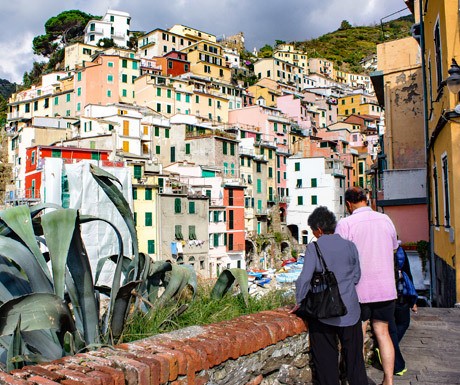
For the luxury-minded traveler, Cinque Terra is the gift to yourself that never stops giving. It will provide you with a lifetime of memories that, because of the unusual scenic treasures, will stand out from the other trips you have taken in your lifetime. It is both a National Park as well as a UNESCO World Heritage site.
A masterpiece of coastal beauty, it shares words like insanely picturesque, deeply colorful and wildly natural all at the same time. Recently, it has been named the “Cinque Terre Riviera.”
Located on the Ligurian coastline west of Spezia in Northern Italy, it is easy to get there by train (visit the TrenItalia website) from any of the larger cities in Italy.
“Cinque Terre” translates to “Five Lands” in English. It is a string of five ancient seaside villages that were built along the coastal cliffs to keep watch for marauding pirates. The pirates were regular intruders from the 1100’s and forward for several centuries. As a major aggravation to the Genoese (the people of Genoa), they decided to build a long string of villages along the coast that would remain on watch for seafaring invaders and send a warning through the string northward to Genoa proper, and inland to other nearby townships and cities.
Today, five of these villages remain for you to visit easily. Each village has its own personality and scenic pleasures. Once you have found a hotel, you will find a variety of ways to move between villages so that you can visit all five of them: a local train stops at all five villages all day long; you can walk on foot-roads, paths, and trails; each village offers local boats (with drivers) that you can rent. Or you can do any combination of these as well.
Giving yourself 2-3 nights in Cinque Terre will enable you to take full advantage of the host of gems that await your visit in each town. Beginning from the most North/Western village Monterosso al Mare down through the most South/Eastern town of Riomaggiore, they are as follows:
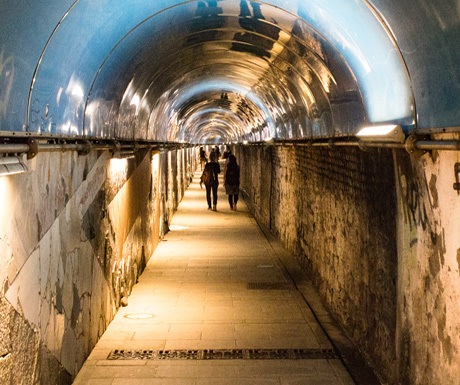
Monterosso al Mare Monterosso has two sections: the old town and the new town, with an interesting tunnel connecting them together. The antiquity of the old town is clearly the attraction with its tiny alleyways, the popular ancient Convent (1600’s Capuchin style) and the square medieval bell tower that is topped by Merlons.
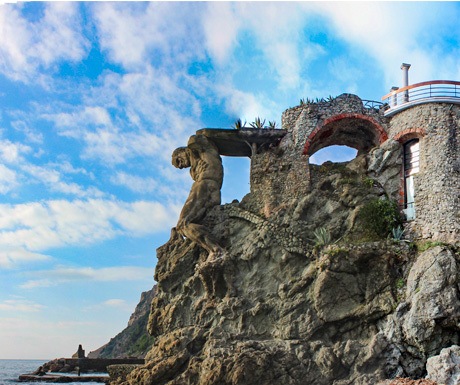
Lemon trees are abundant, and lemon-anything is what you’ll want to enjoy sampling, as the local shop and restaurant owners are certainly experts at lemon everything! Hot day? You won’t find a better frozen Limoncello drink or lemon gelato anywhere in the world. On the north end of her beach is a mega-sized sculpture of Neptune (the Monterosso Giant) carved from the cliff rocks. Upon his shoulders was a giant seashell that doubled as the party patio to the Villa Pastine. But during a WWII bombing of Monterosso, the statue and the villa endured a large amount of Damage. Vernazza Being a car-less community makes this town a delight on foot. It remains to be “one of the truest fishing villages on the Italian Riviera.” The natural port gave the town a water-side defense system, important for these seaside dwellers. During the 1200’s, the port was the place where Naval fleets and soldiers were launched to battle the marauding pirates. The wall around the city was added in the 1400’s as an additional form of defense. Two medieval Churches remain in Vernazza: Church of Santa Margherita d’Antiochia (1318ce) whose octagonal bell tower was added in the 1700’s, and the little stone Chapel of Santa Marta waiting for you on the Main street of the town.
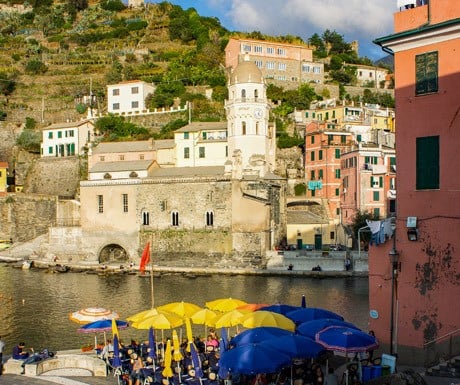
The Doria Castle was the Watch Tower designed to watch for marauders in the 1400’s.
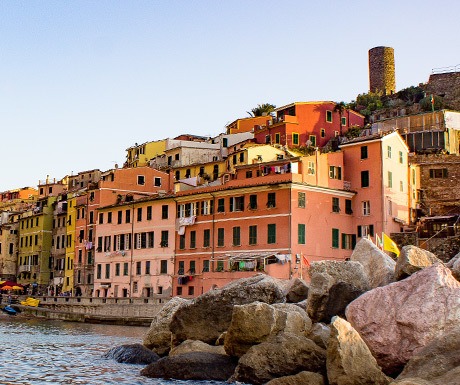
Corniglia This is the only town of the five that does not actually touch the water. Built approximately 250 feet up on the clifftop, it is the center of our 5 pearls. Terraced crops and vineyards surround it on three sides, while the fourth side plummets down to the lapis-colored Ligurian sea. Thus, unlike the other towns, it lacks a sea port. The ancient medieval Church of San Pietro (1350ce) is a popular stop. The only ruins in town is the clifftop fortress built in 1556ce. The main Piazza, Largo Taragio, is the heartbeat of the village with an high ocean view and plenty of local wine. Manarola Manarola is the most photographed town in our string of 5 pearls. With its colorful Genoese-styled tower houses, it will remain in your memory for decades to come. Built in the 1100’s, it offered quite a vigorous resistance to the common Pirate raids. The word ‘Manarola’ derived from the Latin ‘Magna Rota’ or ‘Big Wheel’ refers to the large mill wheel found in the town. The Church of San Lorenzo (1338ce) and Bell Tower are a popular site for visitors. As is the Museum of Manarola, where you will discover the beginnings of this quaint seaside village. The local wine “Sciacchetrá” pronounced shock-eh-TRA) is served with or without food in nearly every food venue in town and must not be missed.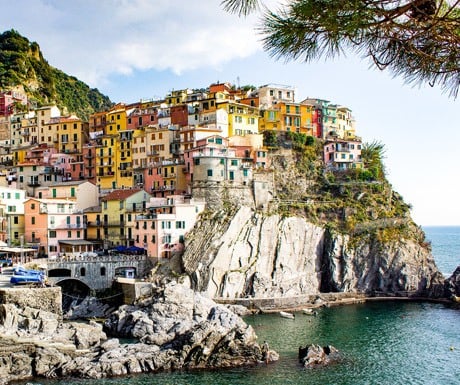
The walking trail between Manarola and Rio Maggiore (Via dell’Amore, “Love’s Trail”) is one of the more popular sites in the town.
]
Riomaggiore The Southern-most of our 5 Lands is Riomaggiore. Built in the early 1200’s, it boasts of medieval charm, delicious local wines, colorful Genoese-styled tower houses, and plenty of shops and restaurants. The path that connects it to Manarola has a local charm that is worth seeing. Oh, and don’t forget that incredible view of the Ligurian Sea.