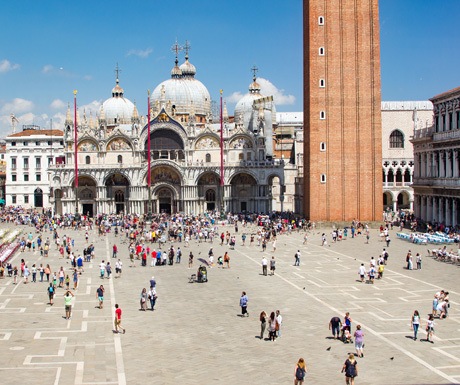
Everyone that visits Venice will go to St. Mark’s Square, period. And you must as well. But how can you do it differently than the millions of selfie-taking tourists while garnering food for your brain and staying cool to boot? Most consider St. Mark’s Square to consist of the Basilica, the Doges’ Palace, and the Bell Tower. But this World Heritage site houses so much more for intellectually-driven luxury travelers; and those that enjoy moving at less than the break-neck pace to which the typical cruise ship tourists must adhere.
Besides those three very populated sites, the St. Mark’s Square complex also includes the Clock Tower, The Museum Correr, the National Archeological Museum, and the Marciana Library. Here is a guide of how to visit the treasures that St. Mark’s Square has to offer at a speed that will enable you to enjoy this fantastic World Heritage Site at a much deeper level. NOTE: Be sure to enjoy St. Mark’s Square not in a single day (as most do), but spread out over several days. Mornings are typically crowded out by huge tour groups, and many of the cruise ships leave port by 3 or 4pm in the afternoon. Any time after they leave, and the sun begins to cool the day will, by itself, enhance your enjoyment of this typically over-crowded Square. Items 5-7 on this list can be enjoyed at any time throughout the day, as they are all indoors, typically uncrowded, and are air-conditioned.
The Doges’ Palace As mentioned, St. Mark’s Square has several popular places to visit. Starting with the Doges Palace, I would recommend that you go online to the “Palazzo Ducale official website.” There, pre-order tickets for the “Secret Itineraries” tour. Take the latest tour in the day that is available. A few minutes before your predesignated time, go to the front of the line and show your reservation for your “Secret Itineraries” tours. You will be directed to the front of the always-long line of tourists, then into the back door secret areas of the Palace by a Museum Docent. Notice you are being led by a Museum Docent rather than by an outside tourist guide.
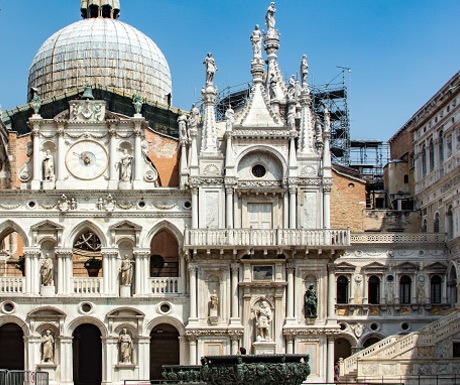
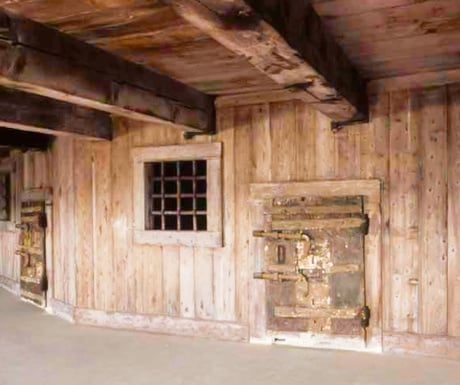
Take a look through the Doges’ offices and administrative areas of a 1,000-year-old political system. Then walk through the ancient prison cells – including that cell where the famous Casanova was imprisoned and ultimately escaped; the torture chamber; and the attic that now houses ancient battle gear. You will emerge back into the main Palace through a secret closet door. (Cool, eh?) Tour the rest of the Palace on your own, but be sure not to miss a walk through the enclosed Bridge of Sighs at the end. This is how you’ll experience the last view a prisoner would see as he was ushered to his new cell.
Saint Mark’s Basilica The Basilica can be best enjoyed once again, at the end of the day. Go online in advance and purchase tickets for a “Skip the Line” tour. Within the Skip the Line category, you will find several offerings that include expert local guides. You will be taken through one of the most beautiful Basilicas you will ever see.
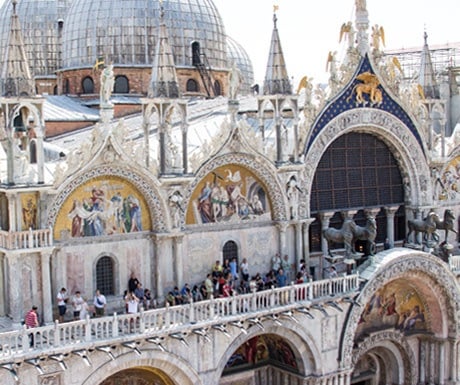
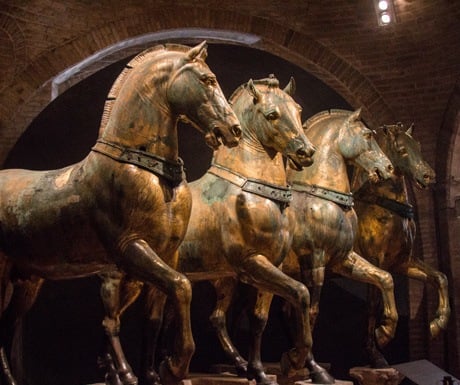
Be sure to go up the hard-to-find staircase to the upper level where you can look down inside the church to get a holistic view. Then turn around and go outside onto the balcony where the 4 horses look down upon the entire St. Mark’s Square. There will be surprisingly few tourists up there, as most flash-through tourists tend to miss this incredible opportunity. Enjoy getting breath-taking photos from the balcony, and don’t forget to visit the one-room museum where you will learn about the copies of these magnificent horses. The original horses are kept inside.
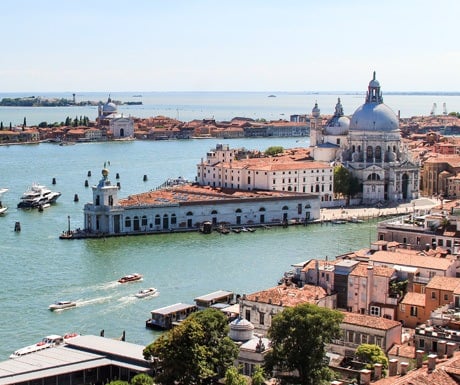
Saint Mark’s Bell Tower Some of the most magnificent views can be enjoyed from the top of this tower. The stunning Punta Dogana and the richly ornate Santa Maria della Salute is a visitor favorite. Don’t worry, you won’t have to climb up stairs, as the elevator will make the ascent fast, effortless and enjoyable. Go to the tower during a morning when you know it will be a clear and sunny afternoon. Purchase your tickets while the line is short, but don’t go up into the tower until around 2-4pm in the afternoon. Most of the day travelers will have left the city by then, and the sun will highlight the best direction for you to get those killer shots! Take your time, there is so much to see both near and far.
Saint Mark’s Clock Tower This is a treat that most miss, and you mustn’t! The Clock Tower overlooks the Square from the side of the Basilica. It is magnificent in design, and clever in execution. Your tour will take you up into the clock tower level by level as you find your way to the glorious view at the top. Learn how the folks from the 1490’s managed to construct such a clever mechanism, and you will get to peek through the round windows over the unknowing crowd. See the statues that used to pop into and out of the clock tower centuries ago. Study the working mechanisms that are both simple and complex at the same time. Afterwards, enjoy the view of St. Mark’s Square from the top of the tower as you exit through a trap door to the rooftop.
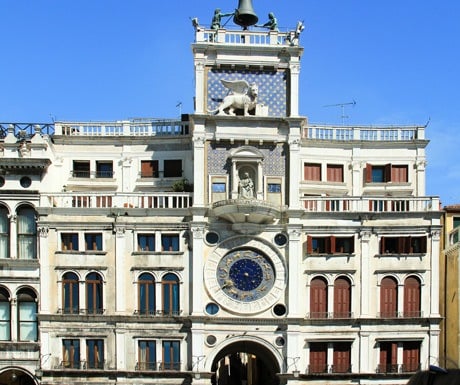
To purchase tickets, you’ll need to walk to the far end of St. Mark’s Square opposite of the Basilica. Look for the entrance to the Museum Correr. At the museum’s front desk, you will purchase your tickets for the Clock Tower. They will give you a time to show up for your tour and provide you with a very knowledgeable guide. No crowds here, because the rooms in the tower will only hold several people at once, and most tourists are not even aware of this unmissable treat. So, enjoy!
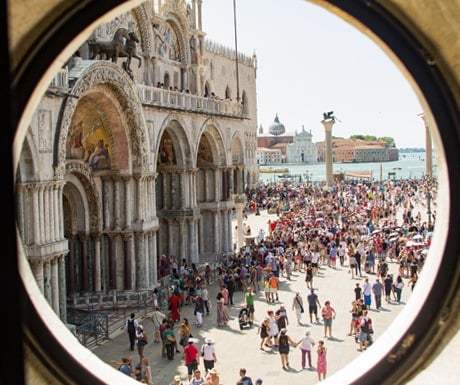
Museum Corre Teodoro Correr was a passionate collector that lived during the late 1700’s, a time of massive change. During such times, it is common that old valuables are sold off at affordable prices, and Correr was there in wait. The time was the late 1790’s when the 1,000-year rule of the Venetian Republic was coming to an end due to the overtake of Napoleon who then traded it to Austria. Our guy Teodoro Correr took advantage of the changing times and purchased valuable documents, art, furnishings, etc. His collection grew into a vast account of the late years of Venice Republic, and can now be enjoyed in St. Mark’s Square. A fantastic way to get to know that period lies waiting for your visit to this museum.
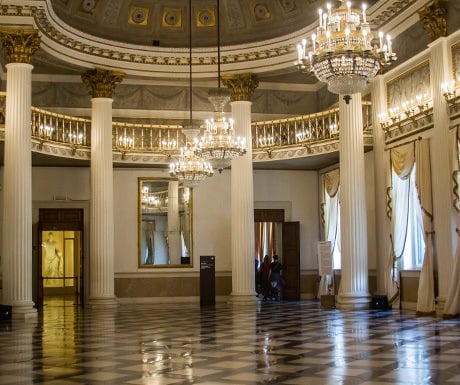
When you are finished with the museum, you must stop into the inappropriately-named Coffee Shop. It serves up a fantastic sandwich or plate of pasta and a wonderful glass of Italian wine. You will enjoy all of this while viewing from the upper level windows over St. Mark’s Basilica at the opposite end of the Square. Although this treat lies within the crowded square, it is mostly overlooked by the time-constrained tourists, leaving you with an uncrowded air-conditioned environment in which you can enjoy at your leisure.
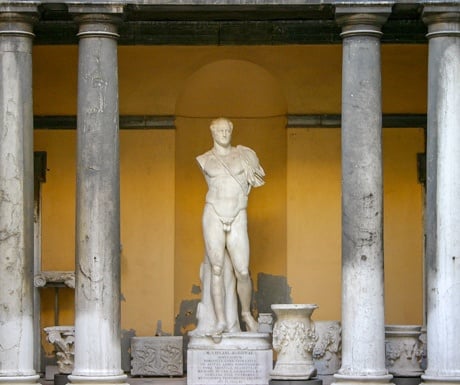
National Archaeological Museum Situated within St. Mark’s Square is the Museum of Archeology. Go back in time to the fifth century BCE and see the stone, inscriptions, and statuary of the ancient Greeks and Romans. See the room of money (numismatics), and rooms full of Roman sculptures of statesmen from the first century BCE. This rare collection has been amassed here in St. Mark’s Square. The ticket you purchased for the Correr Museum will also gain you entrance to this museum as well. Again, a wonderful way to avoid both the heat as well as the crowds as you enjoy filling in your gaps of history.
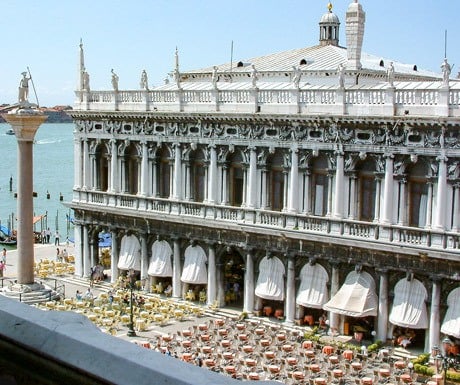
The Marciana Library – The collection of art within this late-Renaissance building will give you a glimpse into the world of “La Serenissima” (The Most Serene). This was the name by which Venice has been known throughout Western History. Enjoy the works of the most famous artists of Venice’s history: Titian (aka Tiziano), Tintoretto, and Veronese. As one of the largest repositories of ancient documents, manuscripts, and texts in the country of Italy, it shouldn’t be confused with the National Archives that are housed across the city. Your ticket to the Correr Museum will also gain you access into this vast collections of ancient literary works as well.
The three museums and the Clock Tower, when combined with the Basilica, the Doges’ Palace and the Bell tower, will provide you with a rare clarity into St. Mark’s Square that only the deeper traveler will appreciate. And as you can see, even though this area of Venice is usually packed with tourists during the peak hours, there are ways that you can avoid the crowds while staying cool, and beefing up your knowledge at the same time. Ciao and happy travels!