GETTING HIGH in Florence: Best rooftop photo spots in Florence Italy

Cameras have evolved into a permanent must-have part of our mainstream culture. Whether it is a part of a smart phone, or a high-end DSLR, we use them to communicate online and off, for email and social media, for business and education. Here are a few of the places in Florence Italy where you can climb up to find the best rooftop photo spots in Florence. When traveling, cameras have become as ubiquitous as a passport. Even more so, because some of us carry more than one type of camera.

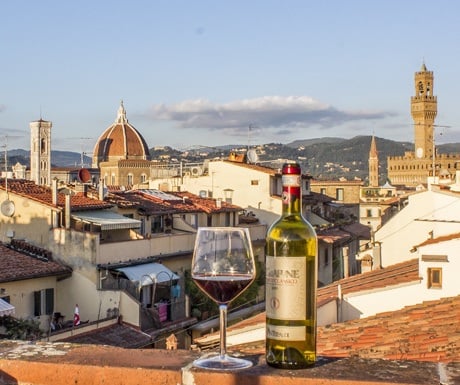
If photography is of interest to you, then you know how important it is to find good angles from which to shoot. Most guidebooks have terrific photos, but they don’t often let you know from where they were shot. Here are a few of the places in Florence where you can climb up to take great scenic shots of this wonderfully ancient city. As you can see, a picturesque palette awaits your climb. Some may require you to purchase a ticket, some are free, and some may require you to enjoy a local Tuscan vino! But no matter which you choose, you will enjoy this rare perspective into the ancient past from above.

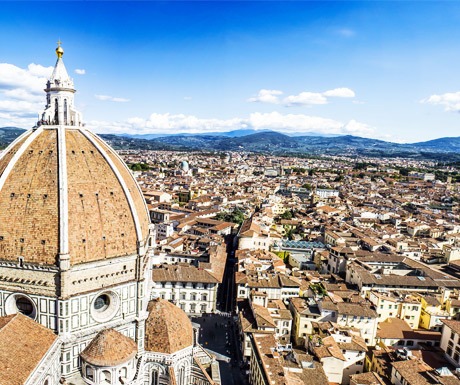
 1. Il Duomo Simply entering this formidable structure inspires awe. And the climb to the top will only add to your amazement. Looking down over the city from the Duomo will give bird’s-eye views from every direction. The unusual part of this view is that Giotto’s Bell Tower, or The Campanile, stands tall right across the same piazza from you which means that if you and a friend each climb one of these structures at the same time, you will be able to get a great shot of each other from these lofty heights! And if you are here because you are looking for best rooftop photo spots in Florence Italy!
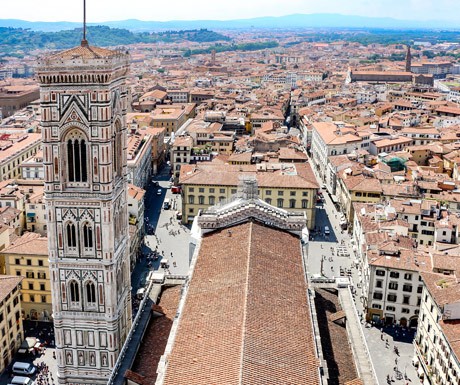
2. Giotto’s Bell Tower (il Campanile) In addition to marvelous views of the city and the Arno from all sides of Giotto’s architectural wonder, next door you will get an up-close view of Brunelleschi’s great architectural creation, il Duomo. This view comes complete with its own scintillating shot of the cupola that is the crown of the city. From atop the north side of the Campanile, you can look down on the eight-sided Baptistery in the foreground, and further away you will see another dome: the Cappella de’ Medici (the Medici Chapel) resting quietly in the near distance. If you decide to scale the 414 steps to the top of this Campanile (Bell Tower) you will see all of Florence. From there, it is easy to imagine that you are looking back through time to the ancient past.
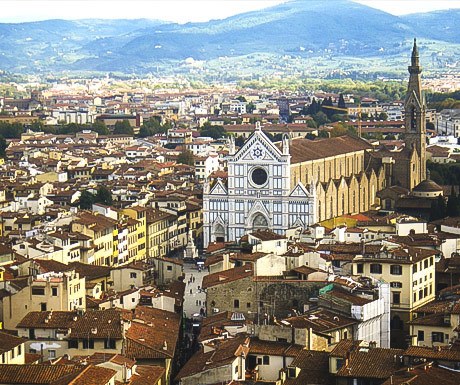
3. Palazzo Vecchio After climbing a mere 223 steps to the top of the Palazzo Vecchio tower, a feast for your eyes awaits you at every single rest level where tiny windows give you a break and a glimpse of what lies below you. Looking southwest from the top of the crenellated tower of the Palazzo Vecchio, you will acquire a terrific view of the Bargello: Initially built as a seat for law enforcement, it later became an infamous prison where from its crenellations, you might have seen a few bodies dangling upside down as a direct message to those that might wish to break the law. Looking southward, the main scenic feature is the Church of Santa Croce (below). With a large piazza out front, you will find musicians and street performers of every kind. But inside is where all the bodies are buried – literally. From a Dante cenotaph to Donatello, and from Florence Nightingale to Michelangelo, this church has become the final resting place for many famous folks.
4. Piazzale Michelangelo Piazzale Michelangelo is a medium-effort walk from the Ponte Vecchio Bridge. But whether you hike it or you take the #12 Bus up the hill, be sure to bring a picnic basket. This is one of the more popular places to end your day and to watch the sun set over the city.
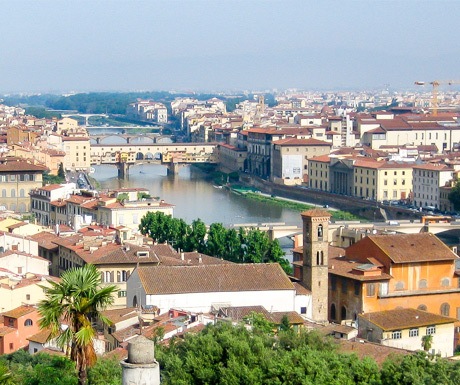
5. Westin Excelsior Hotel This view, taken from atop the Westin Excelsior Hotel on the Arno River (Piazza Ognissanti, 3, Firenze) is clearly fantastico! Day or night, rain or shine, this panorama is quite a sight to behold. Take the elevator to the top (8th) floor, go through the bar and out the glass doors to get this sumptuous feast for your eyes. The 8th floor doesn’t seem very high, but when you are in an ancient city where most structures are a mere 2-3 stories, 8 floors is plenty high!
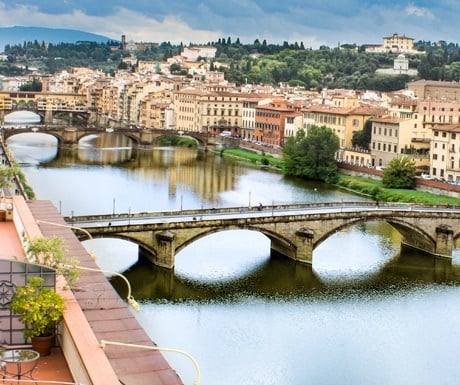
6. Hotel La Scaletta Hotel La Scaletta is a gem in a hidden treasure chest! A bit tough to find: Once you have located the correct building (near the Pitti Palace) you will climb a few steps, take a rickety little 2-person elevator to the top, walk through a small lobby into a restaurant, go out the back door, up some steps to a roof-top bar, then up one more precarious narrow flight to the rooftop. There you will find a couple of small cafe tables waiting for you to savor the wine & cheese along with these fantastic views of the historical center of the city (below), and the Observatory over Boboli Gardens behind you. A very romantic way to enjoy the sunset.
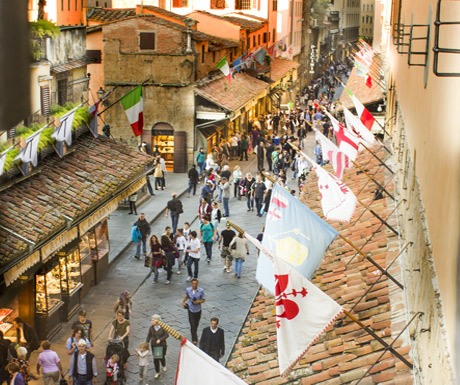
7. Vasari Corridor This view from inside of the Vasari Corridor secretly looks down over the heads of the unsuspecting tourists as they shop for gold jewelry on the famous Ponte Vecchio bridge. The mysterious Vasari Corridor also gives rare views of the Arno and the backstreets of the city as it winds its way over the tops of the buildings between the Pitti Palace and the Uffizi Gallery. Best rooftop photo spots in Florence Italy? Not the broadest view, but definitely a super-secret best rooftop photo spots in Florence Italy
CINQUE TERRE – The Gift that Keeps on Giving

For the luxury-minded traveler, Cinque Terra is the gift to yourself that never stops giving. It will provide you with a lifetime of memories that, because of the unusual scenic treasures, will stand out from the other trips you have taken in your lifetime. It is both a National Park as well as a UNESCO World Heritage site.

A masterpiece of coastal beauty, it shares words like insanely picturesque, deeply colorful and wildly natural all at the same time. Recently, it has been named the “Cinque Terre Riviera.”

Located on the Ligurian coastline west of Spezia in Northern Italy, it is easy to get there by train (visit the TrenItalia website) from any of the larger cities in Italy.

“Cinque Terre” translates to “Five Lands” in English. It is a string of five ancient seaside villages that were built along the coastal cliffs to keep watch for marauding pirates. The pirates were regular intruders from the 1100’s and forward for several centuries. As a major aggravation to the Genoese (the people of Genoa), they decided to build a long string of villages along the coast that would remain on watch for seafaring invaders and send a warning through the string northward to Genoa proper, and inland to other nearby townships and cities.

Today, five of these villages remain for you to visit easily. Each village has its own personality and scenic pleasures. Once you have found a hotel, you will find a variety of ways to move between villages so that you can visit all five of them: a local train stops at all five villages all day long; you can walk on foot-roads, paths, and trails; each village offers local boats (with drivers) that you can rent. Or you can do any combination of these as well.

Giving yourself 2-3 nights in Cinque Terre will enable you to take full advantage of the host of gems that await your visit in each town. Beginning from the most North/Western village Monterosso al Mare down through the most South/Eastern town of Riomaggiore, they are as follows:

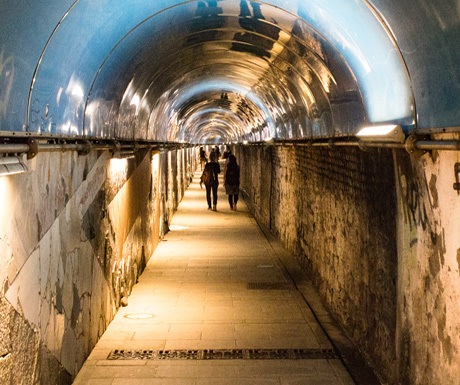
Monterosso al Mare Monterosso has two sections: the old town and the new town, with an interesting tunnel connecting them together. The antiquity of the old town is clearly the attraction with its tiny alleyways, the popular ancient Convent (1600’s Capuchin style) and the square medieval bell tower that is topped by Merlons.

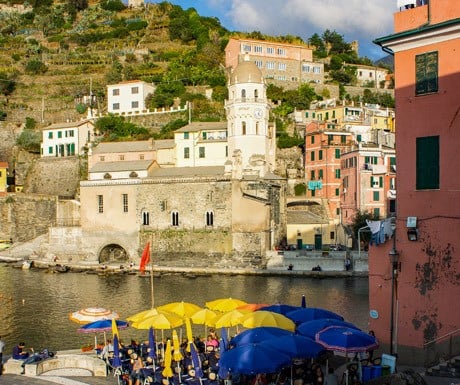
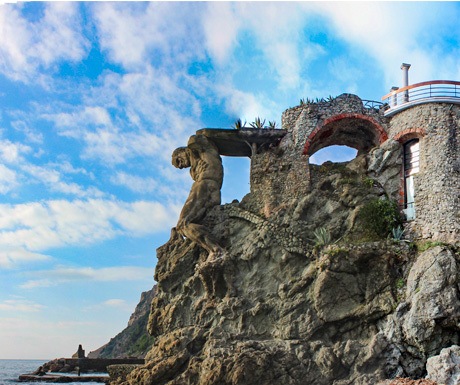
Lemon trees are abundant, and lemon-anything is what you’ll want to enjoy sampling, as the local shop and restaurant owners are certainly experts at lemon everything! Hot day? You won’t find a better frozen Limoncello drink or lemon gelato anywhere in the world. On the north end of her beach is a mega-sized sculpture of Neptune (the Monterosso Giant) carved from the cliff rocks. Upon his shoulders was a giant seashell that doubled as the party patio to the Villa Pastine. But during a WWII bombing of Monterosso, the statue and the villa endured a large amount of Damage. Vernazza Being a car-less community makes this town a delight on foot. It remains to be “one of the truest fishing villages on the Italian Riviera.” The natural port gave the town a water-side defense system, important for these seaside dwellers. During the 1200’s, the port was the place where Naval fleets and soldiers were launched to battle the marauding pirates. The wall around the city was added in the 1400’s as an additional form of defense. Two medieval Churches remain in Vernazza: Church of Santa Margherita d’Antiochia (1318ce) whose octagonal bell tower was added in the 1700’s, and the little stone Chapel of Santa Marta waiting for you on the Main street of the town.

The Doria Castle was the Watch Tower designed to watch for marauders in the 1400’s.


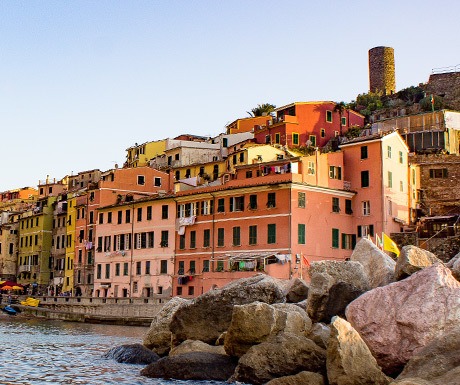
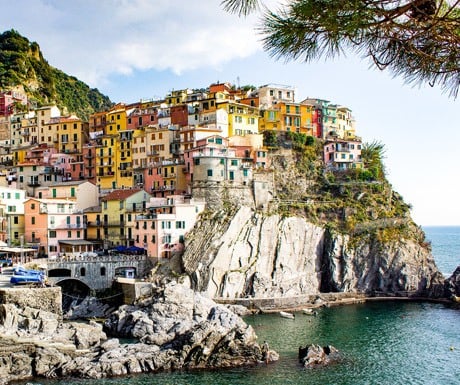
Corniglia This is the only town of the five that does not actually touch the water. Built approximately 250 feet up on the clifftop, it is the center of our 5 pearls. Terraced crops and vineyards surround it on three sides, while the fourth side plummets down to the lapis-colored Ligurian sea. Thus, unlike the other towns, it lacks a sea port. The ancient medieval Church of San Pietro (1350ce) is a popular stop. The only ruins in town is the clifftop fortress built in 1556ce. The main Piazza, Largo Taragio, is the heartbeat of the village with an high ocean view and plenty of local wine. Manarola Manarola is the most photographed town in our string of 5 pearls. With its colorful Genoese-styled tower houses, it will remain in your memory for decades to come. Built in the 1100’s, it offered quite a vigorous resistance to the common Pirate raids. The word ‘Manarola’ derived from the Latin ‘Magna Rota’ or ‘Big Wheel’ refers to the large mill wheel found in the town. The Church of San Lorenzo (1338ce) and Bell Tower are a popular site for visitors. As is the Museum of Manarola, where you will discover the beginnings of this quaint seaside village. The local wine “Sciacchetrá” pronounced shock-eh-TRA) is served with or without food in nearly every food venue in town and must not be missed.

The walking trail between Manarola and Rio Maggiore (Via dell’Amore, “Love’s Trail”) is one of the more popular sites in the town.

]

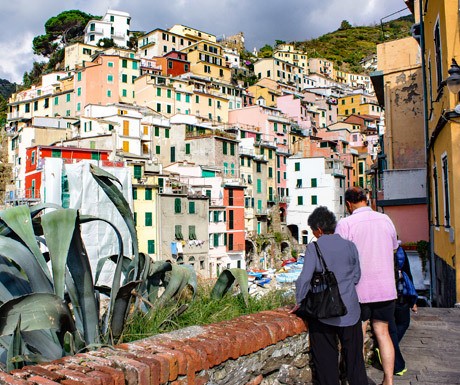
Riomaggiore The Southern-most of our 5 Lands is Riomaggiore. Built in the early 1200’s, it boasts of medieval charm, delicious local wines, colorful Genoese-styled tower houses, and plenty of shops and restaurants. The path that connects it to Manarola has a local charm that is worth seeing. Oh, and don’t forget that incredible view of the Ligurian  Sea.

6 Walled Cities of Tuscany (with a SURPRISE at the End!)

Many luxury travelers have seen the major tourist cities in Italy such as Rome, Florence, and Venice. They have probably even visited the second-tier hot spots of Cinqueterre, the Amalfi Coast, and Sienna. An area of Italy that is difficult to visit is Tuscany. Not because it is hard to find nor even hard to get to. But because it is so vast and there are hundreds of tiny pockets of Italian goodness.

Point of fact: did you know that there are over 200 ancient walled cities in Tuscany? Most of the guidebooks take you through the same half-dozen towns and villages, so when you get there, they are packed with tourists. Here, I will take you through several of these ancient towns and villages, beginning with the most common, and ending with a real surprise that is certainly off that beaten path. Along the way, take the time to enjoy some of the most excellent Tuscan wines from the Chianti region.

Siena is arguably the most famous walled city in Tuscany. As a UNESCO World Heritage site, it enjoys plenty of tourist traffic. This historically-charged city was created by the Etruscans, a pre-Roman culture that thrived from around 700 bce to approximately 400 bce when they were assimilated into the Roman population. The twice-annual horse race, the Palio, is held between neighborhoods (Contrade, pronounced con-TRAH-deh) to determine who gets to be the holder of the most coveted city prize as the top Contrade. The Sienna Cathedral is a medieval Church that will take your breath away. Inside you will find a Carrera marble pulpit along with fantastic works by some of the Renaissance Superstars such as Michelangelo and Donatello. A welcome feature within the Sienna Cathedral is the Piccolomini Library where you will be touched by the sweet images of Raphael in many of the paintings by Pinturicchio, who adored the looks of his most prized student.

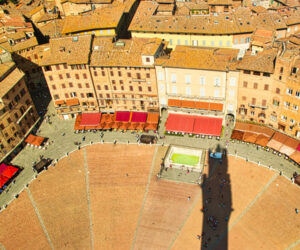
Also, a climb up the Torre del Mangia (seen as a shadow) will gain you an overhead view of not only this captivating walled city but also you will feast your eyes on the surrounding farms and vineyards of the impressive Tuscan Countryside. 

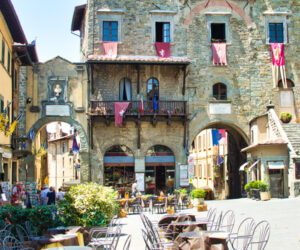
Cortona Upon entering the mighty gates of Cortona, you will be greeted by a straight road heading uphill directly in front of you. A walk up this road will take you to a picturesque and beautiful piazza that you will not soon forget. Cortona is laced with fantastic stories of history that include an essential settlement for the ancient Etruscan people, a battle where the great Carthaginian General Hannibal laid waste to the Roman army during the second Punic War, and where you will enjoy some of the most exquisite food and drink offered in Tuscany.From the wall’s edge, you will look down upon the Chiana Valley to see the enormous Chianina cattle grazing far below. A highlight in Cortona is the excellent Etruscan Academy Museum which displays exceptional examples of ancient pottery, tools, and items of everyday living in ancient times. Additionally, the museum features an Archaeological Park where you can walk Roman Roads, and visit old Etruscan Tombs. The Church of San Francesco boasts a cushion and a tunic said to have belonged to Saint Francis of Assisi. And the Diocesan Museum features paintings by the Renaissance giant, Fra Angelico. 

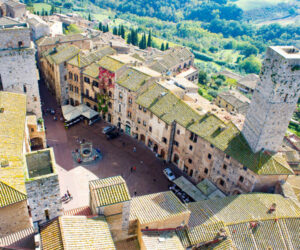
San Gimignano This picturesque medieval city, known locally as The City of Fine Towers, San Gimignano (pronounced san jim-ee-NYAH-no), is understandably a UNESCO World Heritage Site. Surrounded by three walls, this triangular city boasts 14 towers that were created by competitive neighbors. Near the end of the Renaissance period (the late 1500’s), there were as many as 72 tower houses making up the Gothic and Romanesque skyline. Today, the remaining 14 towers still lend to creating a photo-ready ornament on the horizon. A climb up some of these towers will gain you excellent views as you look down upon this 3-sided city, as well as the sweeping Tuscan countryside.San Gimignano pays homage to Saint Fina (Serafina), and inside the Chapel of Santa Fina, you will find stunning frescos created by the Renaissance great Ghirlandaio, the Master instructor to the likes of Botticelli, Leonardo da Vinci, and Michelangelo. The two main piazzas are Piazza della Cisterna, recognizable by its triangular shape and a water cistern in its center, and Piazza Duomo. These piazzas are connected by an ancient tunnel which you much pass through to visit both areas. A main street attraction is the Museum of Torture where visitors are greeted by a seemingly endless wall of human skulls. The museum displays a variety of techniques used for torturing both criminals as well as those who possessed wanted information.

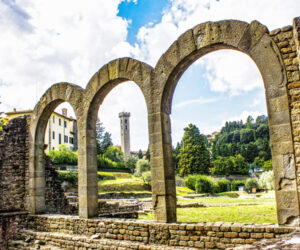
Fiesole For those staying in Florence for a few days, this is the answer to the perfect day trip: Fiesole (pronounced fee-eh-SOL-eh). Simply hop on the bus and go the short 7 miles up the hill. When the bus reaches the end of the line, disembark and look over the wall on the side of the street. Below, you will be treated to an excellent view of the city of Florence. If weather permits, this view is second to none! The medieval homes in the neighborhood will have you clicking away to get some beautiful selfies. When finished here, look behind you to the tall tower. Walk towards it; laid before you will be a stunning archaeological site of an ancient Roman Amphitheater!Buy a ticket and go down into it, and walk through and around it. The cool thing is that when the ancient Romans built this facility, they were actually covering up an even more ancient Etruscan site! The archaeologists did a fantastic job of exposing both cultures in this one incredible site. Apparently, the peace-minded Etruscans who lived in the area, were able to hold off the intruding Romans, until eventually succumbing in 90bc, and were either killed or were assimilated into the Roman culture.The site museum is small but well worth taking time to visit. The objects that were unearthed in the dig site outside will amaze and even amuse you. You will learn more about the Etruscans who were the namesakes of ‘Tuscany.’ This is an A+ way to spend your day! Surrounding this hilltop treasure is a variety of villas inhabited for centuries by wealthy Florentines such as Lorenzo (the Magnificent) de’Medici. 

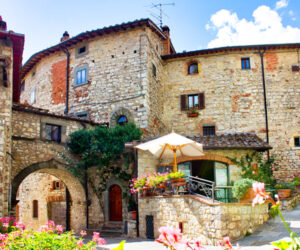
Vertine The tiny hilltop medieval walled city of Vertine (pronounced vayr-TEEN-eh) is the perfect place for those looking to get away from it all. This adorable little village is small enough to stroll around it’s walls in under an hour. Vertine was originally a castle built during the 11th century. A small village eventually grew around it that boasted 7 towers. Today only a single tower remains among the stone homes and shops. During the summer, much of the town is empty, as the home-owners commonly go away to their own summer homes for the season. If your goal is to find a place in Tuscany where you can live among the locals without the intrusion of touristic throngs, Vertine is the place. Use it as a base for wine tasting, as a short 10-20 minute drive in any direction will take you past many quaint and distinct wineries.

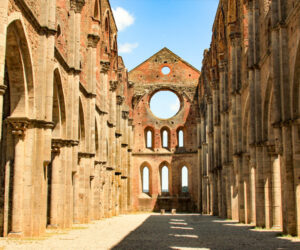
Chiusdino In the title, I promised you a surprise at the end, and this is it: Chiusdino (pronounced kee-us-DEE-no). Why you ask? Read on. Chiusdino sits demurely atop a hill in the Province of Siena. This hilly little village is far from the tourist path, so it holds no popular shopping or tourist attractions. It is merely a warm and delicious local village, home to families that have lived there for centuries. Restaurants? You bet, and proud they are of their local cuisine. A stroll through the quiet streets will lead you to the city museum where you will find their ancient treasures and relics.The town idolizes Saint Galgano, which begins the ‘surprise’ portion of this article. Within the walls of the town itself is the Rectory of St. Michael the Archangel. And within the Rectory is the reliquary which holds the head of Saint Galgano. So, who is this Galgano guy? Galgano Guidotti was a 12th-century fellow that led a barbarous life. In his later years, he had a vision of the Archangel Michael promising to personally protect him. And on another occasion, his horse led him to a spot where, in another vision, he met the twelve Apostles and the Creator himself. It was in this spot, near Chiusdino, where he took hold of his sword and jammed it into a rock. Witnesses were known to have said that ‘…the stone yielded like butter.’ And it was here that he swore to give up his evil-doing and become Pious, which eventually led to his Sainthood.Since then, a fabulous Monastery was built that today is one of the most striking ancient sites you will see. Even though roofless, the San Galgano Monastery works so perfectly with the afternoon sun, that this would be an ideal place for a wedding. And right next door is the little round Abbey of San Galgano that was built around that Sword in the Stone. YES! This is the REAL original Sword in the Stone from the famous Legends of the Round Table. As it turns out, Galgano’s Italian sword was the inspiration for the English author, T.H. White, to pen the story stating that only a good guy, pure of heart, would be able to pull the sword from the stone. SURPRISE!